Why not hand someone a full menu of how they can support your small business?
If you’re a healer, educator or artist, chances are that you could use a contribute page on your website.
Hey, have we met? I’m Shayna, a web designer and developer for creators, embodied entrepreneurs, and service providers like you. Today we’ll walk through how to create a contribute page on your website merging the personal with the professional.

Table of Contents
Why I built mine
It all started with Bear Hebert
Once upon a time (on April 8th, 2026, to be exact), I binged a resource called Freely, a potent series of workshops by Bear Hebert. That day, I couldn’t sleep at 5 a.m. and started with the introduction. By the end of the day, in between all my other goings-on (flamenco class, freelancing, etc.), I was done and had listened through every last Q&A call.
While the workshop was recorded in 2019, it was just what I needed to hear. I was grateful to Bear for putting the generous content out there and making it available. While I was already a fan of Bear’s work before, after reading their 2018 essays on why they don’t teach yoga, I became that much more enamored of the craft of the anticapitalist business coach. I found Bear’s approach to business “for weirdos,” at least from what I explored through Freely, as medicinal.
It was right here in Freely that Bear tipped off the Contribute page idea for me. They mentioned a tip jar.
If you have a podcast—you know, anything like that—that’s where you’re offering a lot of good useful content for free that’s outside of the context of a paid program. That’s something where a tip jar or a donation button can be really useful for you, because there will always be people who are going to sign up for your free content, who are going to listen to every podcast and watch every IG live and never sign up for anything.
—Bear Hebert in Freely
Bear’s teachings about money, pricing, and creative sustainability have definitely influenced my work. In Freely, they elaborate on their own tip jar and its URL location.
The other thing is, I have a tip jar on my website. It’s BearCoaches.com slash Contribute. And if you want to give me some money, because I helped you write a sales page, but I didn’t actually help you write a sales page, I also welcome your tips.
→ Visit Bear’s Contribute page here
What a contribute page is, and what it is not
A contribute page holds the menu of how a website visitor may support your unique business. It’s broader than a tip jar, which is one feature on a contribute page. The page itself holds the full range of ways a person might support your work: financially and non-financially.
A nonprofit website may also use a contribution page, meaning a donation form or streamlined payment flow used to collect money. This is not what I am describing. A contribute page as a creator’s page answers the following question: What are all the ways someone might support what you do, from passive to active, from free to paid?
There is a broad spectrum here that makes it a menu rather than a checkout. It’s not that shares, likes, subscriptions and follows are wrong. But they’re not the only Calls-To-Action. And for you, they might not be the most important ones.
Why you might build a contribute page
If you walk into a bar, restaurant or cafe and ask for a menu, you’re not going to get weird looks (unless you live in parts of Spain, LOL, where it’s expected that you don’t ask for the menu).
Similarly, you can look at a spa menu when you’re booking a spa reservation. Lashes, nails, waxing, massage, facials… They’re all on the menu.
We might think we know all the ways to support a creator or service provider…
But we won’t actually know until looking at the menu.
A contribute page allows you to gently guide and delineate for your visitors how you’d like to receive support, recognition, and contributions.
We’re on so many platforms (of the algorithmic variety) these days that we make assumptions about what support feels like or ought to be.
You might have requirements or preferences of how you’d rather express gratitude for—and profit from—the attention, capacity, and goodwill of folks who want to support you.
Don’t assume a website visitor knows what you want or need, any more than you know what’s on the mind of the people you follow.
It can feel a bit vulnerable to really put out there any and everything that you could actually use help with. It is a place on your website where you tell people unequivocally, in your words, what support looks like. And yet, the vulnerability is also the whole point of the contribute page.
There’s no harm done in spelling it out so that it’s crystal clear.
Plus, let’s face it. Not everyone is on every platform. The contribute page allows folks to be self-selecting about where they’re going to engage or sign up or follow.
That’s what this page is for!
So, let people guide themselves as they peruse your menu.
Allow them to back your mission, vision, and plans. Your creativity. Your precious life energy and expressed grace.
Let’s not waste any time second-guessing if or how.
People genuinely do want to help you
People genuinely do want to help you, and they won’t know precisely how to help unless you tell them. Why not spell out and count out the ways?
A referral, a podcast review, a forwarded newsletter, a paid subscription, a tip, a workshop registration. Naming these out loud puts the energy into the universe.
Robin Wall Kimmerer cites the gift economy extensively in Braiding Sweetgrass.
The essence of the gift is that it creates a set of relationships. The currency of a gift economy is, at its root, reciprocity.
The contribute page names how the people who read, listen, and watch your valuable content can tend their relationships with you. Some will pay, some will share, some will simply pay attention. It all counts; “all flourishing is mutual.”
You offer something valuable, and in exchange for what you have given, you can receive gifts in return.

Respect one another, support one another, bring your gift to the world and receive the gifts of others, and there will be enough for all.
—Robin Wall Kimmerer, Braiding Sweetgrass
You might be surprised that someone will go through every widget and follow you on all your platforms. Or an angel investor out of the blue will drop a windfall of cash into your tip jar.
Stranger things have happened.
Passive vs. active support
Passive support examples are actions that can help you when you’re not active somewhere. For instance, if you get a follower on Instagram, that passive presence has value (even if you’re not on IG on the daily plan or the monthly plan or the quarterly plan). A YouTube subscriber count lends channel credibility, even if you’re not posting there regularly. A LinkedIn connection can lead to a referral, even if you only log on every three months.
I personally love the contribute page because it actually states my digital minimalism philosophy and why I’m not on social media all the time. This signals trust, rather than going quiet on every online profile with no given context at all.
So, folks following you on a platform allow a “passive” presence to add to visibility on that platform.
Again, you have the benefit on the contribute page of really making your support preferences known in the ways to contribute.
What if you’re a podcaster? Tell them about your podcast. What if you’re not on social media? Let them know. What if you’re a blogger? Link to your blog. What if you’re a hardcore newsletterist? Make it all about your newsletter. What if you only work 1:1 through a niche networking group? Say it and link to the group.
Active support is involvement like sponsoring, volunteering, co-hosting, and referring a client. It ups the ante. It’s not a one-click commitment.
You get to really pick and choose what you want more help with. Maybe you’d like people to read your new book chapters. Maybe you want people to support an experimental service, or fundraiser, or your latest digital product, or a legacy project.
Name it. Name it all.
What to include in a contribute page
My contribute page contains ten sections, but I won’t walk you through them one by one. You can see that on my live page. Loosely grouped, there are four clusters holding up for me, so you can decide which ones make sense for you.
1. Referrals and network
Have someone support you by sending the right person your way. Good old-fashioned word of mouth. On my page, this shows up as 01 refer (“do you know someone who needs a website?”) and 02 network (“let’s cross paths and be in each other’s circles”).
There may be a collaboration opportunity between your business and another’s, just an email away. There could be someone in your professional network who is a good connection for that of your next website visitor. Invite that person in!
2. Content support
This is the cluster about everything that helps your content travel: subscribing, sharing, forwarding, leaving a review, writing for you, appearing on your podcast, cross-posts, attending an event, etc. Most of it is free. On my page these five separate sections are 03 write or appear, 04 share, 05 subscribe, 07 follow, and 09 attend.
3. Financial
The 08 tip jar lives here. I run two tip jars on my page: one through Wise (my preference for multiple currencies internationally) and one through Kit Commerce (no account needed, includes a photo of my grandmother Lola’s favorite flower). I include affiliate links to both, because hey—why not mutually benefit.
Bear said it well:
Also, I really recommend putting a tip jar on your website. If you have a website, just put a tip jar there. If you make content on the internet, tell people that you have a tip jar. You make a lot of videos on whatever platform you’re on, have a tip jar and say, did you like this video? Want to buy me a coffee? Just make a little place where people can donate any amount of money. It’s nice.
—Bear Hebert, Freely Q&A, February 2026
I’m grateful to Bear for not being above it and modeling the tip jar in action. Now I’m doing the same!
If you have a website, just put a tip jar there. If you make content on the internet, tell people that you have a tip jar.
—Bear Hebert, Freely Q&A, February 2026
4. Structural and get-involved
This cluster may be easy to skip: Sponsorships, co-hosting, volunteering, structural collaboration. Getting hands-on. On my page, this is 06 get involved (“Steward Season Two of the Equitable Wellness Podcast“), and it nods to barriers around sustainability and long-term capacity. I decided on adding this section so that folks do understand structural realities and see that hard work more clearly.
Nonprofit websites also include these kinds of Calls-To-Action. Others want to build toward the future that you are seeing for your work, and this section invites those people to do so.
May you not go through it alone!
How to build a contribute page (an MVP-first approach)
To take the minimum viable product approach, you don’t need to start with ten sections (though I understand the allure!). Yours can start with three or even a singular tip jar, minimalist approach, like Bear has it.
Get started
I recommend literally spelling out and writing down every single way you can imagine and think of people supporting you.
Sketch out the categories in a mini visual menu, or scribble it out furiously on paper.
Then organize and whittle down what you want to include on the page.
A workable minimum:
- A short, warm welcome that says who you are and why the page exists
- One financial option (a single tip jar is enough)
- One or two non-financial options that genuinely help (a referral form, a newsletter signup, a podcast follow link)
- An anchor navigation menu (or not) at the top, so people can jump to what is relevant to them
- A short attribution and an invitation at the bottom
A few build notes from doing this myself:
- Use anchor links. A long page with a jump menu reads as a menu, not a wall. People scan, then click.
- Pick tip jar tools that match your audience. Wise is great if your audience is international. Kit Commerce, Buy Me a Coffee, and Ko-Fi are easier if your audience just wants to click and go. There are many options. Toi Marie Smith (see example below) links out to a book registry for books she wants to read, via bookshop.org.
- Redirect a memorable slug. I use
/contribute. Bear uses/contribute. Short, semantic, easy to say. If you have used a different slug in the past, set up a 301 redirect so old links keep working. - Update it as your work changes. Iterate, create & celebrate. New podcast season, new offer, new collaboration: update the page.
Try it
If you build your own page, I would love to see it. And if you feel so inspired, reference me, link out, and attribute. I was inspired by Bear Hebert, and I’m happy to share that.
Visit my Connect + Contribute page to see how mine is put together, then build out yours.
Happy Building!

p.s. Don’t forget the CTA!
I didn’t mention yet one of the best reasons to build a contribute page: you will always have something to quote and link to at the end of every newsletter or blog post or places where you leave a mark.
For this swipe file, I’ll end with Toi Marie Smith’s newsletter CTA.
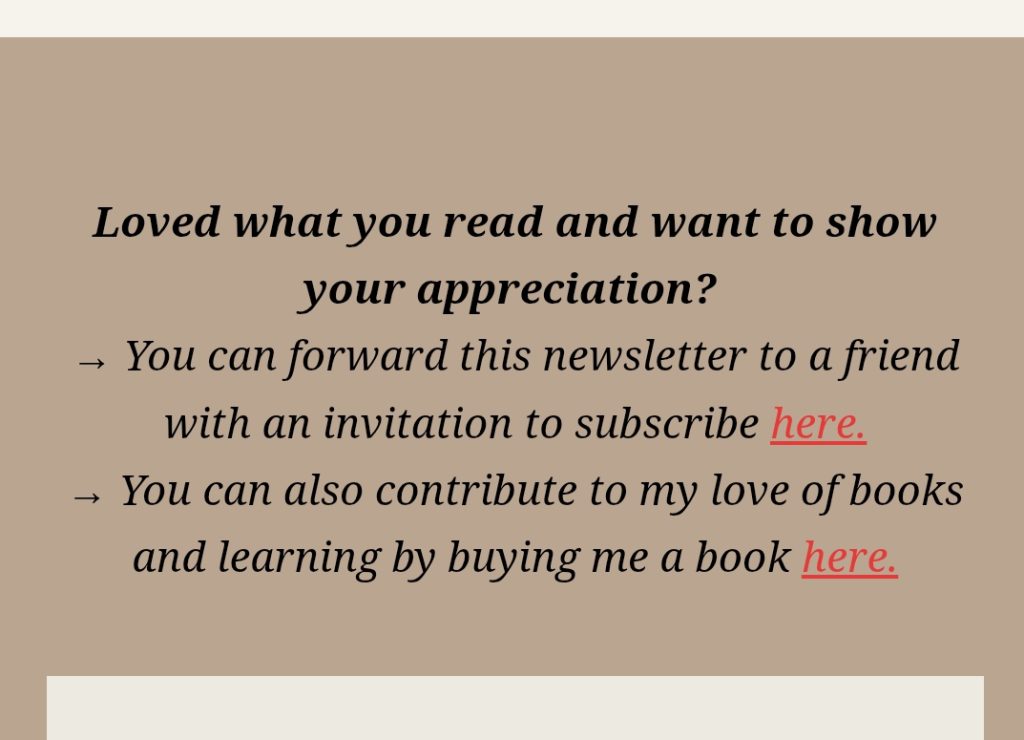
→ Subscribe here to Toi Marie Smith’s newsletter
→ Visit Toi Marie’s book registry here
Now that you’ll have your own connect + contribute page, you can end newsletters or blog posts with a refrain like this. This is again inspired by and adapted from Toi Marie’s example.
Example refrain (swipe file to emulate, adapt, and share at the end of your own posts):
Loved today’s blog post?
→ Forward this to a friend and invite them to subscribe.
→ For more ways to support my work, visit shaynagrajo.com/contribute.